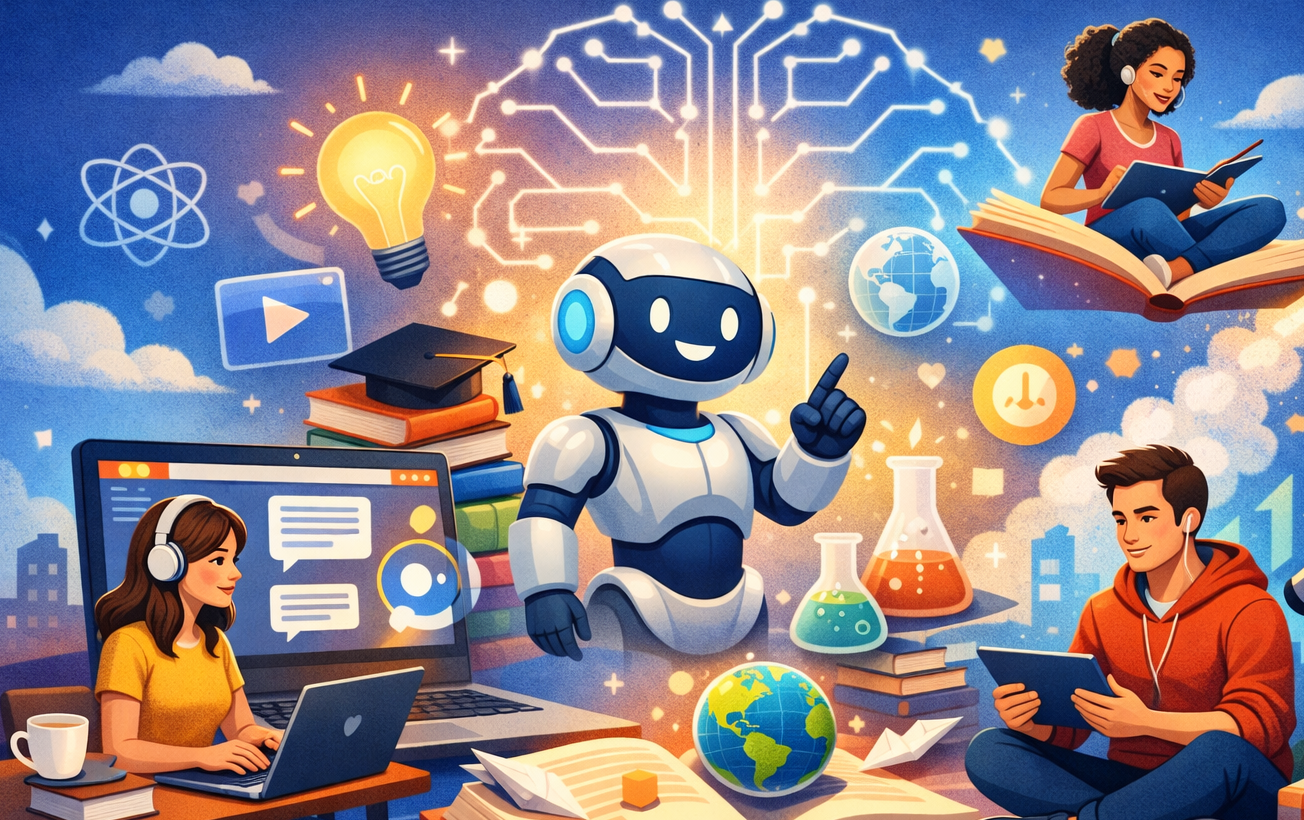
How can a mere mortal use AI to help them learn new things and explore new ideas?
Artificial intelligence can feel like something reserved for techies, data scientists, or people who say “algorithm” unironically. But the truth is AI is becoming an everyday learning companion for mere mortals like you and me – it’s for the busy professionals, the curious dabblers, and the “I’d love to learn this but where do I even start?” crowd.
Wanting to learn something new is normal human curiosity, but how can you use AI to learn faster, think more clearly, and explore ideas we might never have touched before.
Why AI is a powerful learning accelerator
The biggest barriers to learning as adults aren’t intelligence or ability – they’re time, confidence, and knowing where to begin. AI can help with all three:
- It summarises complex topics into something you can grasp quickly.
- It adapts explanations to your level of knowledge.
- It gives you a safe space to ask “silly” questions without judgement.
- It helps you practise, test yourself, and explore ideas from different angles.
Think of it as being a patient tutor, a research assistant, and a brainstorming partner rolled into one.
Real-world examples (for real-world people)
1. Learning something completely new
Let’s say you want to understand project management, gardening, public speaking, or how solar panels work.
You can ask an AI:
- “Explain this to me like I’m new to it.”
- “Give me a 10-minute overview.”
- “What are the three most important things I should know?”
- “Create a simple learning plan I can follow for 20 minutes a day.”
Suddenly, the mountain becomes a hill.
2. Turning curiosity into clarity
Ever read an article and thought, “I understand the words, but not the meaning”?
AI can help you unpack it:
- “Summarise this in plain English.”
- “What’s the author really arguing?”
- “Give me examples from everyday life.”
It’s like having a translator for complicated ideas.
3. Practising new skills safely
Want to get better at writing emails, preparing for interviews, or giving presentations?
AI can role‑play scenarios with you:
- “Pretend you’re a difficult customer – let me practise responding.”
- “Ask me interview questions for a management role.”
- “Help me rewrite this email so it sounds confident but not rude.”
You get instant feedback without the pressure of a real audience.
4. Exploring ideas before committing time or money
Thinking about a new hobby, a side project, or a career shift?
Ask AI to help you explore:
- “What’s it actually like to run a small online shop?”
- “What equipment do I need to start 3D printing?”
- “What are the pros and cons of becoming a freelancer?”
It’s like doing a risk-free test drive.
5. Making sense of your own thoughts
Sometimes learning isn’t about new information – it’s about organising what’s already in your head.
AI can help you:
- Brainstorm ideas
- Map out a plan
- Break a big problem into manageable steps
- Challenge your assumptions (gently)
It’s a thinking partner that never gets tired.
What AI won’t do (and this is a good thing)
AI won’t replace your judgement, your creativity, or your lived experience.
It won’t magically make you an expert overnight.
And it definitely won’t do the learning for you.
But it will make learning faster, less frustrating, and far more enjoyable.
The bottom line
You don’t need to be technical.
You don’t need to understand how AI works.
You just need curiosity – and a willingness to ask questions.
AI is not here to outsmart you.
It’s here to amplify you.
If you can think of a question, you can accelerate your learning.